
Peaceful Tank Mates for Betta Fish in Small Aquariums
We all want a beautiful Betta fish, but we don’t necessarily want only one fish in our tank. So, what fish can you keep with your aggressive Betta fish to add color and visual interest to your tank? Here, we will list peaceful tank mates for betta fish in small aquariums to help you achieve a peaceful community tank.
When looking for tank mates for your Betta, looking at fish or invertebrates with similar temperature requirements and companions that aren’t aggressive or territorial is best.
The Best Betta Fish Tank Mates List
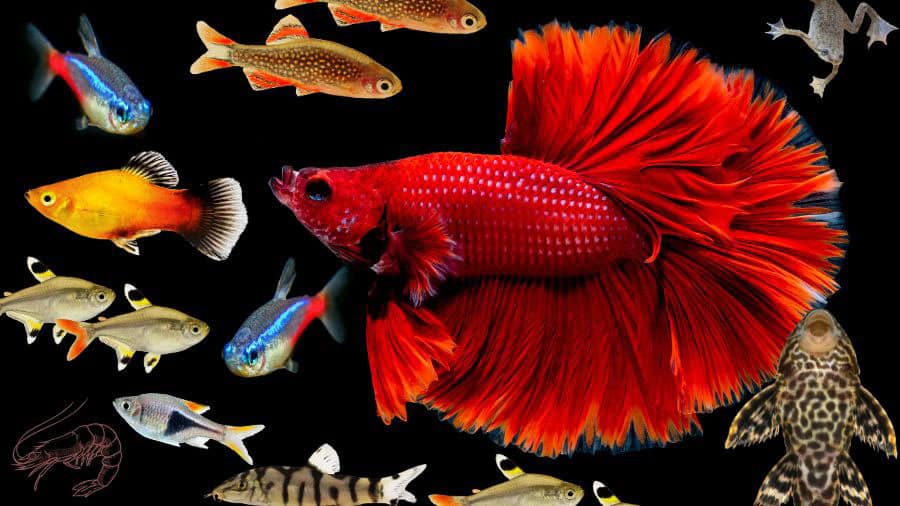
As mentioned, each Betta fish has its own personality, which might be a little trial and error. Incorporating live plants for hiding spaces is a great way to ensure a peaceful community fish tank.
What Makes a Good Betta Tank Mate
Before picking species from any list, think about the type of tank mate that suits a Betta.
Good tank mates usually:
- Prefer similar warm temperatures
- Are peaceful and non territorial
- Do not resemble a male Betta
- Do not nip long flowing fins
- Occupy different areas of the tank, such as the bottom or mid level
- Are fast enough to move away if chased, but not so fast that they constantly outcompete the Betta for food
A planted tank with plenty of hiding spots, caves, and line of sight breaks is almost essential for a calm Betta community. Live or artificial plants both work, as long as they give fish places to rest and retreat.
Best Betta Fish Tank Mates List
Every Betta has its own personality. Some will happily ignore tank mates, while others will not tolerate anything that moves. Always introduce new tank mates slowly, watch closely over the first few days, and be ready with a spare tank or divider if it does not work out.
Below is a guide to common options and how many of each to keep, assuming you have enough tank volume and filtration to support a community.
Tetras
Suggested group size: 10 to 12 in a suitable tank size
Tetras are schooling fish that feel safest in larger groups. They do best in longer tanks where they can swim together.
Good options include:
- Ember tetra
- Neon tetra
- Green neon tetra
- Lemon tetra
- Silvertip tetra
- Ruby tetra
- Purple tetra
Tetras work best in larger Betta community tanks rather than very small aquariums. For most of these, aim for at least a well planted 20 to 30 gallon tank so the school and the Betta all have space.
Rasboras
Suggested group size: 8 to 10
Rasboras are another peaceful schooling group that often pair well with Bettas when given enough room.
Popular choices:
- Harlequin rasbora
- Chili rasbora
- Kubotai rasbora
- Neon green rasbora
- Neon blue rasbora
- Neon red rasbora
- Espei rasbora or lambchop rasbora
Smaller rasboras can be an option in a 10 gallon tank with a single Betta, provided the tank is planted and lightly stocked. Larger shoals and more active species still suit bigger tanks better.
Danios
Suggested group size: 10 to 12
Danios are active and quick, so they need space and usually prefer cooler water than Bettas. The smaller species below are sometimes kept with Bettas in larger setups.
Examples:
- Celestial pearl danio
- Gold ring danio or Danio tinwini
They are better choices for longer community tanks where they can school and move around without constantly zipping past the Betta in a tiny space.
Catfish
Suggested group size: 1 to 2 of the larger species, or a small group of dwarf types if tank size allows
Bottom dwelling catfish are often some of the easiest Betta companions, since they usually stay out of the Betta’s way.
Options include:
- Corydoras julii
- Bronze corydoras
- Panda corydoras
- Cory catfish or quarry catfish
- Otocinclus or dwarf suckers
- Bristlenose pleco
- Whiptail catfish or twig catfish
Corydoras and otocinclus are usually peaceful, active on the bottom, and prefer to be in groups. A small group of corydoras can be a good match in a 20 to 30 gallon Betta community. Bristlenose plecos and whiptails need more room and good filtration, so they suit larger systems rather than tiny Betta tanks.
Gudgeons
Suggested group size: 2 to 8
Gudgeons can be colorful, interesting bottom or mid level fish.
Example:
- Peacock gudgeon or peacock goby
They generally need stable water conditions and a tank with many caves and hiding spots. They are more suited to larger planted community tanks alongside a Betta.
Loaches
Suggested group size: 5 to 8 for the social species
Loaches are active bottom dwellers that usually like to live in groups.
Common options:
- Kuhli loach or eel loach
- Clown loach
- Yoyo loach or Almora loach
- Zebra loach
Kuhli loaches are the most realistic option for a Betta community since they stay relatively small and like to wriggle among plants and decor. Clown and yoyo loaches grow large and need big tanks, so they are not suitable for small Betta aquariums.
Platies
Suggested group size: 3 to 6
Platies are hardy, colorful livebearers.
Some varieties you might see:
- Panda platy
- Mickey mouse platy
- Rainbow platy
- Gold platy
- Sunset platy
- Tuxedo platy
They are usually peaceful and active in the mid to upper levels. They are better suited to medium sized community tanks, as they are quite active and also breed easily, which can lead to fast stocking increases in a small aquarium.
Invertebrates: Aquarium Snails
Suggested number: 1 to 5 depending on tank size
Snails can be excellent tank mates for Bettas, especially in smaller aquariums where extra fish are not a good idea.
Common snail choices:
- Mystery snail
- Nerite snail
- Malaysian trumpet snail
Snails help clean up uneaten food and algae. Nerite snails are especially popular because they cannot breed in freshwater, so they will not overrun the tank. Mystery snails grow larger and can become a focal point in a nano tank.
Invertebrates: Aquarium Shrimp
Suggested number: 10 to 15 in well planted tanks
Shrimp can work with some Bettas, but it is very individual. Some Bettas ignore shrimp, while others consider them snacks. Dense planting and many hiding places improve the shrimp’s chances.
Options include:
- Cherry shrimp
- Amano shrimp
- Bamboo shrimp
- Ghost shrimp
Cherry and ghost shrimp are more likely to be hunted, so keep that in mind. Amano shrimp grow larger and can sometimes do a bit better with Bettas, especially when the tank has plenty of cover.
Amphibians
Suggested number: 2 to 4 in the right tank size
A common amphibian option is:
- African dwarf frog
They share similar warm water requirements, but they are slow eaters and need food delivered near them so they do not starve. In a Betta tank, make sure the frog is getting its share of food and that the Betta is not constantly harassing it.
Tank Mates to Avoid with Bettas
Some fish that look fine in the store can cause serious problems in a Betta tank.
Try to avoid:
- Fin nippers that will bite at the Betta’s long fins
- Any fish with long flowing tails or bright colors that resemble a male Betta
- Fast, hyperactive fish that constantly outcompete the Betta for food
- Very large or aggressive species that can bully or injure a Betta
- Multiple male Bettas in one tank
A bare tank with no plants or decor is also risky. Without cover, tank mates cannot escape if the Betta decides to chase them.
Can a Male and Female Betta Live Together
The honest answer is maybe, but it is not usually recommended as a long term setup.
In most cases:
- A male and female Betta are only kept together temporarily for breeding
- Stress and aggression are common if they are housed together long term
- The female often ends up hiding in a corner or behind plants, showing clear signs of stress
If you want to try this, the tank must be large and heavily planted, with many hiding places and a backup plan ready, such as a separate tank. At the first sign of chasing, torn fins, or constant hiding, separate them immediately.
For most Betta owners, it is safer and kinder to keep only one Betta per tank and focus on carefully chosen community species or invertebrates if the tank size allows.
What Size Tank Do I Need for a Betta Community
Tank size is one of the most important parts of making Betta tank mates work.
- 5 gallon tank, about 18.9 liters: Best for a single Betta. There is usually not enough space to add other fish. You can safely add live plants, a few shrimp if your Betta allows it, or a snail.
- 10 gallon tank, about 37.8 liters: This can work for a Betta plus a small group of bottom dwellers such as kuhli loaches or a few corydoras, or a snail and shrimp. The tank should be planted to give everyone cover.
- 30 gallon tank, about 113.5 liters, or larger: This is a better size for a true Betta community with schooling fish like tetras or rasboras, a small group of catfish, and possibly an African dwarf frog, as long as stocking is kept reasonable and filtration is strong.
As you add more tank mates, focus on:
- Stable water parameters
- Regular water changes
- Good filtration with gentle flow, since Bettas do not enjoy strong currents
For very small aquariums, the safest and most peaceful companions are usually plants, a few shrimp, or a single snail. As the tank size increases, you can start introducing carefully chosen fish that match your Betta’s temperament and your available space.
